High-Fidelity WAN & Application Performance Analytics
PROBLEMS WE SOLVE
- Limited visibility into performance on key enterprise WAN links (branches, remote offices, external partner connections
- Hard to diagnose link degradation, SD-WAN tunnel issues, and last-mile instability without reliable measurement.
- Inability to understand real application behavior across WAN connections.
- Overlay/underlay mismatch with no unified analytics for tunnel vs. physical link health.
- Lack of actionable data for WAN capacity planning and service-provider accountability.
OUTCOMES
1
Rapid isolation of WAN issues down to specific branch, ISP path, tunnel, or physical link.
2
Faster RCA supported by packet-level and transaction-level evidence.
3
Better WAN capacity planning and improved user experience through jitter/loss reduction and stable routing.
CORE CAPABILITIES
Critical-Link Monitoring (Branch / External Partner / Core Inter-Site)
Dual Mode: Deep Packet Capture (L7) + IPFIX / NetFlow Remote Monitoring
Application & Transaction Observability (Real L7 Metrics)
SD-WAN Tunnels Mapped to Physical Circuits
Detect Tunnel Flaps, Jitter, Asymmetric Routing, ISP Congestion
One-click PCAP Extraction Linked to Any Metric / Host / Tunnel
USE CASES
Branch office WAN degradation
What happened: Users in a branch office experienced slow access to SaaS applications. Netis detected abnormal jitter and intermittent loss on the branch’s last-mile circuit, confirming degradation on the ISP side.
Outcome: The operator escalated the ISP ticket with precise evidence. The provider fixed the line, and SaaS performance returned to normal without further user complaints.
SD-WAN tunnel instability
What happened: IPSec/SD-WAN tunnels between HQ and a partner site were flapping intermittently. Netis correlated underlay packet loss with overlay tunnel resets and identified the problematic upstream hop.
Outcome: The routing team updated SD-WAN path and policy selection. Tunnels stabilized, reducing session drops and improving application reliability.
Inter-site application latency
What happened: Business traffic between two data centers became slow during peak periods. Netis revealed increased queueing and micro-congestion on a specific backbone circuit.
Outcome: The network team initiated a capacity upgrade plan for the congested link and implemented short-term traffic engineering measures, immediately improving business system responsiveness.
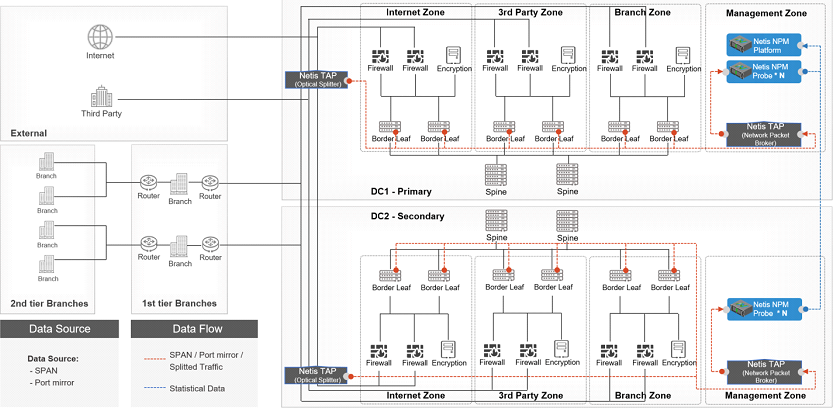
Mini architecture